
Have you ever thought that you would benefit from a simple, text-based assurance case format that would be human-readable, used in communication with AI tools, and at the same time formally defined and importable into the tool?
Here it is. Very simple, but useful text format.
The Lightweight Text Assurance Case (LTAC) format can be used to:
- create assurance case arguments based on data from other systems using scripts, AI tools, or other tools;
- exchange argument data between applications when the limited scope of information is sufficient;
- present arguments in text format in a way that is easy for humans to understand.
You can create arguments and argument branches from LTAC text in PREMIS. You can also get LTAC text for your argument or any argument branch.
LTAC Argument Example
Sample LTAC argument is presented below. This text has been inserted into PREMIS and the GSN diagram shown on the right produced.
- Claim G1: The system is acceptably safe for operation
  - Context X1: System specification
  - Strategy S1: Argue safety by mitigation of all hazards
    - Claim G2: All hazards have been identified
      - Evidence Ev1: Hazard analysis (HARA report.pdf)
    - Claim G3: All hazards have been mitigated
- Link Ev1 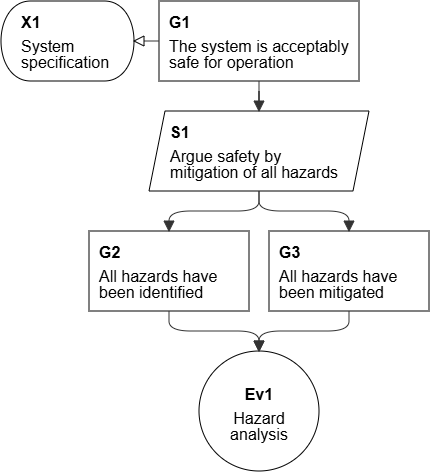
LTAC Syntax
- The argument is presented in a text format, each argument element in a separate line.
- Each line begins with a dash followed by a type keyword, an identifier, a colon ‘:’ and element name
- The allowed element type names are: Claim, Strategy, Justification, Evidence, Context and Assumption. These types can be mapped to GSN, CAE and TRUST-IT.
- Each LTAC argument starts with a claim. It can contain more than one top claim.
- Relationships between elements (such as InContextOf, SupportedBy in GSN) are represented by indentation of two spaces.
- Each element should be specified once only. If an element supports or provides context for more than one element, each reuse should be presented by a keyword Link. This represents a citation of the given element. See Link Ev1 in the example argument above.
LTAC Specification (version 1.1.2, 26.02.2026)
When you are using AI tools, you can request to “produce an argument in LTAC format” and give a link to LTAC specification: https://www.argevide.com/documents/ltac.txt
Further development in progress
We are currently working on an LTAC update. The planned changes include:
- Comment lines starting with #
- Mapping to OMG SACM v2.3
- Packages that correspond to argument modules
- Citations of elements in other packages (which corresponds to away elements in GSN)
- Adding options to argument elements in curly braces
LTAC applications
Final comments
As one of our goals is to make LTAC arguments easy for humans to comprehend, we keep the format as simple as possible. However, we are considering introducing some extensions in the future. We will update this page to reflect the latest version of the LTAC specification.
One of the LTAC limitations is that it supports definitions of argument elements’ names only, not full descriptions. Adding descriptions would make the text rather difficult for humans to comprehend. When you need longer descriptions or other attributes, we recommend more advanced argument formats, SACM or other models in XML or JSON format. LTAC is intended for use when you are working on small argument structures.
If you have any comments or suggestions for changes in LTAC please contact Andrzej Wardziński.
License
LTAC is licensed under the Creative Commons Attribution 4.0 International License.
To view a copy of this license, visit http://creativecommons.org/licenses/by/4.0/